
Visiting Jim Morrison's grave
Remembering the artist behind the image

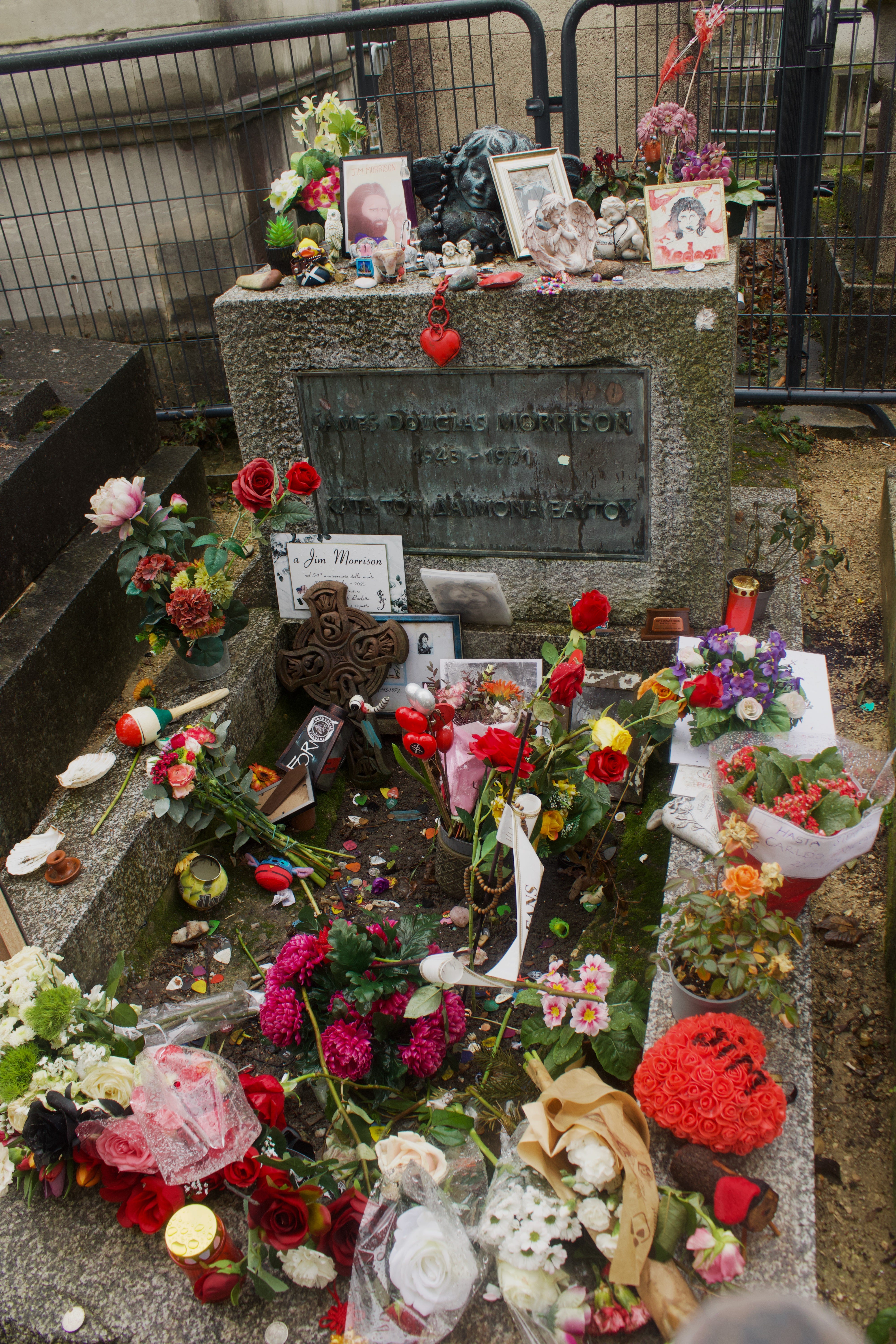
Sparrows dart and linger in the wet, black branches of the naked cherry trees. The gravestone marble glints in the faint midday sun struggling through the clouds. The sky is a sheet of textureless white. After the rain there is a cool, airy quiet that falls on the grass and cobbles of Père Lachaise Cemetery.
I have found my way here through the gothic mausoleums, stone crucifixes and statues of praying angels to find Jim Morrison’s grave. The cemetery is huge, and it is easy to get lost. As well as the many monuments to famous writers such as Moliere, Edith Piaf and Oscar Wilde, there are memorials to the victims of the Holocaust, to the memory of the communards executed in 1871 and the many who died in national tragedies in recent decades.
Contrary to my expectations, Morrison’s grave is not covered in graffiti and there are no large groups of dope heads smoking and nodding their heads to Spanish guitar. When I arrive only a small group of middle aged French men stand at the railings.
One man in a leather jacket is playing Riders On The Storm on his iPhone. Another one in a hiking jacket and flat cap takes pictures quietly. When these men leave the grave is shrouded in quietness. Sometimes I see other tourists flash between the gravestones only to hear their quiet muttering disappear along with footsteps on crunching gravel.
Morrison’s legend obscures his achievement as an artist. He became a figurehead for hedonistic scandal and rockstar glamour, while in fact he was an educated and thoughtful thinker. He created his own individual art form, a peculiar stage presence that was grounded not, contrary to popular belief, in outbursts of adolescent rage, but in a studied and conscious vision of stagecraft. He understood, and had original ideas about, the role that spectacle plays in the spiritual life of modern society.
He also has a personal significance for me. He inspired in my 14-year-old self a love of learning. He showed me that being well-read could be a source of self-realisation as opposed to being purely a matter of getting good grades at school.
Before Jim, I was well on my way to being another millennial drop-out, a morose teenager whose sole references to culture were Top Gun, Kurt Cobain and The Wonder Years. My inner life had no substantial relation to the things I was ‘supposed’ to read or which were taught in school. I was not a good pupil.
After discovering Morrison, I realised that Shakespeare could play the same personal, liberating role as John Lennon or Liam Gallagher. Rather than being fixed monuments that had to be venerated at a distance, the great cultural achievements of literature and art could be creative and transformative agents in my life.
Morrison had mastered the tradition, had internalised the classics, and was able to wield them against the very guardians of artistic heritage who used great works as the basis of hierarchy and authority. Reading the tradition was now an act of rebellion.
This realisation was compounded by a stern lesson I got from my grandmother when I expressed a desire to be a poet. She asked me whether I had read Milton or Chaucer, whether I had understood Shakespeare. She then gave me a pile of books—anthologies mostly, as well as one book about poetic form. Her lesson was simple: you have to know the rules before you can break the rules.
I can remember lying on her couch in the summer one day, reading about Jim with the sun coming in through the wide bay window. I read about his high IQ, his friends testing him on random books in his collection, his love of philosophy and symbolic psychology. It clicked. He was proof about what granny had said. The most effective rebels are those who know the rules before they rewrote them.
Morrison’s performance style, his seemingly chaotic, dangerous and ‘unpredictable’ antics, were far more studied and self-conscious than they at first appear. Once you look into the kinds of ideas he was exposed to while studying at Florida State University and UCLA, so much of what seemed reckless and aggressive in his stage behaviour can be shown to be calculated theatrical experiments.
Drawing on his readings of Nietzsche, Antonin Artaud, and the courses he did on the sociology and psychology of crowds, Morrison used abject histrionics as a deliberate way to confront his audience.
He did this because he understood the dangers and the possibilities of mass gatherings and mass communication. The antidote to complacency, mob hypnosis and crowd conformism was the shock of surprise, the trickster’s ability to use cringe and disgust as a weapon of higher awareness.
Even his infamous and controversial outbursts on stage in Miami in 1969, when looked at through the prism of Morrison’s background in the theatre arts, turn out to be strategies of performance rather than explosions of egotistic hysteria or mental instability.
At this concert he allegedly exposed his penis and taunted the crowd about everything from Adolf Hitler to sexual politics. It resulted in him being arrested for ‘indecency’ and being shunned by the music industry. Evangelical reactionaries held rallies at football stadiums to condemn him. In the midst of fabricated scandal (there was never any proof that he exposed himself), Morrison’s artistic risk-taking was deliberately overlooked.
At Miami, not only was he trying to demolish his sex-symbol image, he was aiming to pierce the smug hedonism that had taken over rock concert audiences. What had been in 1966 gatherings of newly-enlightened spiritual seekers, had already become by 1969 exercises in glib self-stupefaction. The counterculture had turned into another way for people to relinquish their agency. Creative rebellion had given way to fashionable licentiousness.
Morrison knew rock was becoming institutionalised, another instrument of collective control rather than a liberation of consciousness. His antagonism of the audience at Miami and the near-riot that ensued, was an attempt to arrest this degeneration.
For his troubles, Morrison and his band were banned by gig promoters and jeered at by fellow musicians and the Pharisees of the rock n’ roll press. Though he was subsequently put on trial by right-wing reactionaries in Florida, he was simultaneously abandoned and sacrificed by the hippie culture that had once celebrated him. All because he consciously tried to up the stakes of live performance and save rock from the decadence of lazy escapism that eventually killed it in the 1970s.
I stand for about twenty minutes by Morrison’s grave, studying all the paraphernalia collected in the flower bed under his headstone. There are hearts made out of roses, keyrings in the shape of Stratocasters, plectrums, photographs of Jim at the height of his power and beauty and even a map of Florida, his home state.
There is a maraca, a large wooden Celtic cross, candle holders and sea shells dotted along the marble walls. On top of the headstone are statuettes of winged angels and cherubs.
Despite the slightly kitschy bric-a-brac, the grave is austere and quiet. Jim is at peace.
The concrete walls of the cafe-bar are painted black. The tables surfaces are faux wood plastic. Outside there is only one tourist couple on the terrace. Inside, the place is cramped and dark. At the back wall there is a bar with steel trimmings, lined with taps for cheap lager and soft drinks.
Middle-aged men sit on the stools joking and gossiping with the barman, a balding man with a beard and glasses. A group of teenagers huddle around a small table eating sandwiches. There are two office types using laptops, one of them conducting a zoom call by stealth.
In the corner at the end of the bar, an elderly lady in an apron watches the flow of customers with a blank gaze while she polishes cutlery. Every now an then she directs her eyes at me. A tall man with deep, black skin and wearing a floral shirt busies himself between the bar and the terrace, making coffees and managing the tabs. He nods appreciatively at me for not ordering in English.
I’m here really to use the toilet and to charge my phone, but I read a little Baudelaire while I drink an espresso. After leaving Jim’s grave I took the metro up Bastille and walked around the Marais area. This is the part of Paris Morrison lived in before he died.
In the early seventies this was a bohemian district with boutique cafes and bakeries and fashionable night clubs. Now it has the atmosphere of a business district. Clean, quiet, all but deserted. There are still antique shops and wine stores, independent bars doing quirky menus. However, like Fitzrovia or Soho in London, much of the character of the place has been homogenised away.
My walk around the district is something of a disappointment. I’m not sure what I am looking for exactly. A place to read and write with a sufficiently artistic atmosphere would be a start. Most modern coffee shops are overly hip with surly baristas who work there only for the smug prestige of being associated with a ‘cool’ hotspot. The old world cafes are now tourist haunts and overpriced. And of course, there is a middle ground of chain shops and consumer big brands.
So a small grubby cafe like the one I am in now, while not a hotbed of creative electricity, is preferable and something of a relief. It is clearly family run and a local for taxi drivers and shop owners in the area. And the decaf actually tastes like coffee, rather than watery gravy.
I suppose what I’m really looking for is the bohemia of candlelit cafes, of the midnight wine. It is a world without halogen lights and hissing, blasting traffic. Without smartphones and endless jet engine whines crowding the sky. It is a world of barefoot poets and that look of fire and mischief in the eyes of Camille Claudel.
It is a world in which conversations about God, beauty and the meaning of the French Revolution are not dismissed as pretentious. It is world in which every statement of value is not reduced to political implications. It is a world in which any talk of the human longing for the eternal is not sneered at as an out-of-date distraction. In which the erotic is not collapsed into the pornographic or met with puritanical grandstanding.
Is all this really too much to ask? Is it just cringy romanticism? If so then we would have to gather up centuries of human culture and toss it all on to the stinky rubbish fire of contemporary life and just submit to the digital glare of streaming platforms and smug TikTok clips.
We would have to take Shakespeare, Dante, Botticelli and Rodin and pour them down the toilet bowel of our own self-satisfaction. Or worse, we can just turn them into mere touchstones, marks of attention-grabbing achievement and technical fascination to be posted on social media in order to show everyone we are living our best life.
If associating artistic accomplishment with hope for human potential meets with nothing but cynical embarrassment, then culture becomes just a game of rank and reputation. Beauty becomes a badge of status not the means by which we become fully human.
In an interview to promote The Doors’ first album in 1967, Jim Morrison said:
I am interested in anything about revolt, disorder, chaos-especially activity that seems to have no meaning. It seems to me to be the road toward freedom... Rather than starting inside, I start outside and reach the mental through the physical.
In a later interview in 1970, while his trial for the Miami incident was still ongoing, Jim clarified the point he was trying to make here. He said that what he meant by ‘activity that seems to have no meaning’ was activity that embodied a sense of freedom and creative play. He said:
‘…all I mean by that is free activity. Play. Activity that has nothing in it except what it is. No repercussions. No motivation. Free... activity. I think there should be a national carnival, much the same as Mardi Gras in Rio.’
Morrison was no celebrant of postmodern nihilism. As anthropologists of religion tell us, a necessary step from the profane to the sacred is exactly the kind of revery Morrison is talking about in the above quote.
For Morrison, and for The Doors as a band, art and live performance were meant to be an antidote to the dehumanising utilitarianism of industrial society, mass media hypnosis and consumerism. The very name ‘The Doors’ signifies this artistic humanism.
Yes, the name comes from Aldous Huxley’s book, The Doors of Perception. And yes, that book detailed Huxley’s pioneering experimentation with psychedelic drugs. However, Huxley himself spends much of his time discussing education and the need for a spiritual evolution to match the unprecedented evolution in technology and mass politics that industrialisation had brought about.
If humanity is to avoid destroying itself, Huxley believed, it needs to advance beyond the rule of appetite and instinct, and to recognise that there is a form of intelligence and knowledge that extends further than mere technical rationality.
A society based on technological and political advancement only, is a society that is capable of creating hell on earth. Advancements in knowledge must be accompanied by advancements in consciousness, or else the new-found powers of industry and communication will become servants of power-lust and and narrow fear.
So Morrison’s appropriation of Huxley’s book title was not just a celebration of drugs culture. The Doors’ message was the absolute opposite of ‘turn on, tune in, drop out.’ Huxley saw psychedelic drugs as a means by which ordinary people could activate their latent potentialities.
Unless we have a direct experience of the oneness of existence and the untravelled regions of our inner worlds, we will be passive victims of the forces of technology and manipulation that characterise modern life.
For Huxley, modern human societies are imprisoned by ‘words and notions',’ the limiting of experience in the abstractions of language and concepts. The ancient mystical traditions, both Eastern and Western, speak of a realm of reality that transcends our normal conceptions and which is the ground of connection and oneness. Huxley writes:
‘Systematic reasoning is something we could not, as a species or as individuals, do without. But neither, if we are to remain sane, can we possibly do without direct perception, the more unsystematic the better, of the inner and outer worlds into which we have been born. This given reality is an infinite which passes all understanding and yet admits of being directly and in some sort totally apprehended.’
Drugs were an important part of creating this direct experience, but for Morrison, art, poetry and the heightened awareness that can be generated in live performances were just as important.
The ultimate aim was activating the hidden possibilities of human freedom. Say what you want about Jim Morrison as a poet or as a person, you cannot accuse him of not practicing what he preached.